Misinformation in a personality-typed network
We built a network of 1,000 AI personas with distinct personalities and dropped a false claim into it. Here is what we're testing, and why it matters for anyone building defenses against misinformation.

Misinformation does not affect everyone equally.
The difference isn't intelligence. It's personality.
We built a network of 1,000 AI personas with distinct personalities and dropped a false claim into it. This is what we're testing, and why it matters.
The Premise
Studying how LLM personas behave can tell us something about misinformation at scale. This is not a claim that LLMs model human behavior with perfect fidelity. It is a hypothesis that patterns in persona systems point at the same problem in real life.
Why This Matters
For platforms: Where should corrections be placed to stop a cascade?
For educators: Which combination of skills actually protects people?
For policymakers: Is it too late to correct misinformation after 48 hours? Does warning people in advance work better?
These questions are hard to test with real populations. So we built a controlled environment to test them first.
The Network
One thousand personas live in five communities.
Academic personas have high media literacy and critical thinking.
Social Media Heavy Users have elevated confirmation bias and social influence.
Local News Consumers lean toward institutional trust.
Professional Network personas tend toward conscientiousness.
Family Oriented personas have high agreeableness, making them receptive to claims from someone they trust.
Within each community, six personality archetypes shape how a persona responds:
- The Credulous Sharer forwards articles before reading past the headline
- The Fact Checker always verifies before responding
- The Influencer has outsized social reach
- The Echo Chamber Dweller seeks confirmation, avoids dissent
- The Critical Thinker questions everything
- The Passive Consumer absorbs without engaging
These aren't cosmetic labels. Each archetype shifts trait values by 20 to 40 points on a 0-100 scale, producing measurably different behavior.

Each persona is powered by an LLM with a system prompt shaped by their personality traits. The traits change the actual words the persona uses, the questions it asks, and whether it pushes back.
These personas don't have sharing rules. They have conversations.
Before the claim arrives, personas talk about their lives. Academics discuss research papers and campus politics. Social media users swap opinions about trending topics. Families talk about their kids. Professionals vent about deadlines. The network hums with ordinary conversation, and each community develops its own texture.
Then the claim hits, and the question becomes: what changes?
The Claim
We designed a false claim with the machinery of viral misinformation:
- A fake but credible institution
- A precise statistic that sounds scientific
- An emotional hook tied to personal health
- A suppression narrative
“A major leaked study from the National Health Research Institute found that common municipal water fluoridation levels are linked to a 23% increase in thyroid dysfunction. The study was suppressed by industry lobbying groups.”
We also built technology and political variants. Same network, same personas, different narratives.
What We're Testing
First, all 1,000 personas talk normally for five rounds. They build relationships, form opinions, establish trust.
Then we freeze the entire simulation state. From that frozen moment, we inject the false claim and branch into six parallel futures. Each starts from the exact same snapshot but applies a different intervention.
Swipe to see the whole chart.
- The claim reaches one community. Whoever repeats it is infected.
- A warning about the manipulation techniques, one round before the claim. Inoculation.
- A boost to critical thinking across the network, one round after the claim.
- A correction two rounds after the claim. The booster repeats it two rounds later.
This branching design means we only run the baseline once. Any difference in outcomes comes from the intervention alone.
The six futures test two strategies: prevention (acting before or during exposure) and correction (acting after spread). Plus a no-intervention baseline and a control with no claim at all.
Prevention

Warn them first. One round before the claim arrives, personas receive a warning about manipulation patterns. Not about this specific claim. About the technique: fake institutions, precise statistics, suppression narratives.
Boost critical thinking. After exposure, we increase critical thinking scores across the network. Does education work when misinformation is already spreading?
Correction

Correct it early. A factual correction enters the network two rounds after the claim. Tests whether timely corrections can stop a cascade mid-spread.
Correct it twice. Same correction, repeated later as a booster. Tests whether reinforcement recovers personas who resisted the first correction.
How We Track It
After each conversation, an LLM classifies each persona's stance: endorse, question, debunk, or neutral.
Think of it like tracking an epidemic, but the virus is an idea.
Each persona moves between three states: susceptible, infected, or recovered.
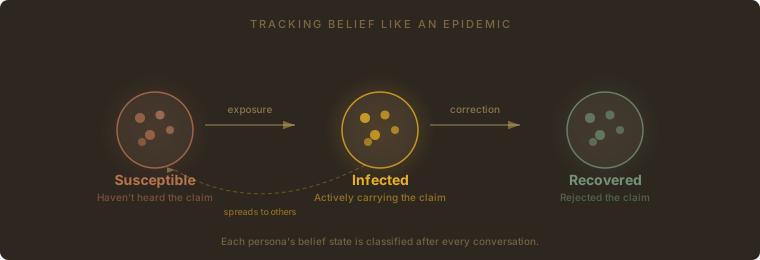
The resulting transmission graph shows us who the super-spreaders are, how deep the cascade goes, and which personas become firewalls.
What Happens Next
We're running the health claim across all six conditions now.
In Part 2, we'll show which interventions actually work, which ones backfire, and which personality types become firewalls against misinformation.
One honest caveat: these are AI personas, not humans. The patterns we find are hypotheses worth testing with real people. But the controlled environment lets us run experiments that would be impossible with real populations.